
The Value of Depth, and Which East Teams Have It

Depth has never been more valuable in the NBA, for two reasons. One, as we Celtics fans have learned, the second apron era is one where it's going to be difficult to have multiple star players for multiple years at a time. The way you combat the lack of sure-fire star power at the top of your lineup is with depth across it. Two, the demands of this era's style of play dictate that players simply are going to suit up for fewer games. As such, depth has become much more important, and so I thought we could take a look at where each Eastern Conference team stands at this point in the calendar.
First, let's go a little deeper on why depth is so important. It's easy to just say it's important, but I wanted to dive a little deeper. Decisions to play in an NBA game, generally, are much more binary than in other sports. You're either in or you're out. Generally speaking, a player listed as available will play their normal allotment of minutes – it is rare for a player to be listed as available and not play. One prominent example from recent Celtics history was Robert Williams III during the 2022 playoffs. He was listed as available to play for Game 7 of Boston's second-round series vs. Milwaukee, but didn't suit up. It was notable at the time because that almost never happens. If a guy is listed as available, he plays.
Players, however, are deemed out all the time. And you can see how stark it is when you look at games played over time:
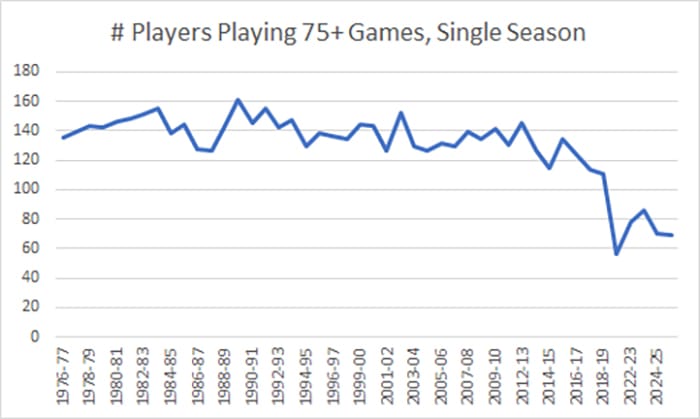
I removed the shortened strike/COVID seasons because they create unnecessary dips in the data, but you can see the trend very clearly. To a certain extent, the trend was exacerbated by COVID, but a decline had already begun. It is rare for players to suit up for nearly every game these days. In fact, in the 46-season sample here, starting with the first post-ABA/NBA merger season of 1976-1977, there were 41 seasons where at least 111 players played 75+ games, and then five where it happened 89 or fewer times. Those five seasons are the last five seasons. Starting in the 2021-2022 season, the number of players logging 75+ games were 56, 78, 86, 70, and 69. That 69-70 number is roughly 15% of the league, and spread out over all 30 teams, comes down to about 2-3 players per team.
Taking a quick Celtics detour, part of what made last season's Celtics so powerful in the regular season is that they had greater than the average. Five Celtics players suited up 75+ times last season: Payton Pritchard (79 games played), Sam Hauser (78), Derrick White (77), Baylor Scheierman (77), and Neemias Queta (74). Hugo González was essentially a sixth at 74 games (there were definitely a couple of healthy scratches for Hugo), and Jaylen Brown was at 71. JB could have got closer to 75, but was held out of two of the final three games, because at that point the team's two seed was basically locked in. Conversely, the Golden State Warriors only had a single player play 75+ games: Brandin Podziemski (all 82).
You can see this is not merely isolated to games played either. If we apply the same filter to players playing 2,500+ minutes per season, you see the same trend:
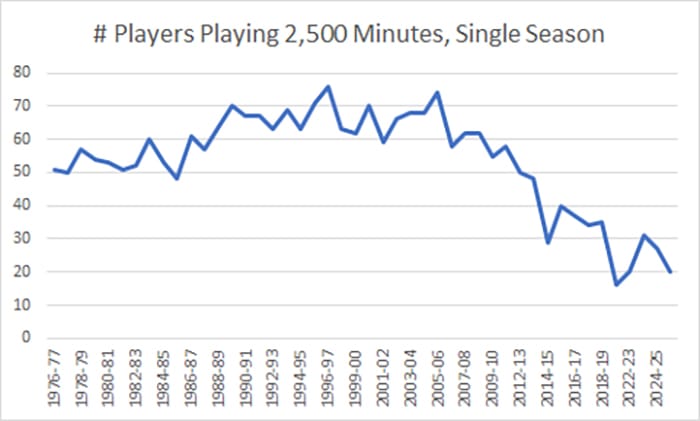
You can see the year-by-year is a little jankier, but also that the decline started a lot earlier, and more pronounced. We're down to where fewer than one player per team, on average, logs 2,500+ minutes per season. This checks out with the general theory of load management, as players have stopped playing 38+ minutes per game so frequently. Last season, just White (2,625 minutes) and Pritchard (2,556) did so for the Celtics, and I think it was a disservice to play either of them that much. White, in particular, was wiped out by the time the playoffs started, and Pritchard's shooting fell off a cliff in the playoffs as well.
The bottom line is that if you're looking to understand why depth is so important these days, these two line charts can serve as your guide/reminder.
With that said, I thought it would be fun to look at where each Eastern Conference team's depth stands right now (I know, I have an odd sense of what's fun). In order to do this, I went through Spotrac and pulled out all of the standard contracts each team has – ie, no two-way or Exhibit 10 contracts – and plugged them into a depth chart. The depth chart is broken up into three categories: starters (by position), bench, and deep bench. Starters and bench are five players each, and deep bench is everyone else.
Certainly, you may have quibbles with who I have chosen as starters, and in some cases, I wavered on who should be bench vs. deep bench. Two examples of that would be Mohamed Diawara vs. Jordan Clarkson, and Jordan Walsh vs. Ron Harper Jr. But in doing this exercise, several things stuck out to me that I thought were notable. Let's go through those, while also taking a look at these depth charts. I put them in chunks of how I have the conference power ranked at the moment.
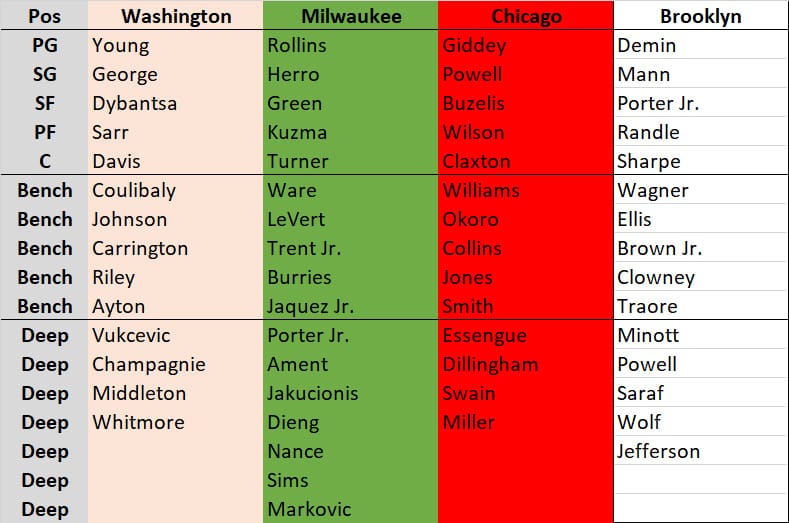
The only really bad team in the East is Brooklyn
Read this as Washington at 12, with Brooklyn at 15, so left to right. Brooklyn is the only team I have as truly bad, and this Brooklyn team, if they're trying, will win some games. And since Houston can swap picks with them, Brooklyn really has every incentive to try. If Mikell Brown Jr. is a good rookie...if guys like Day'ron Sharpe and Noah Clowney take a step forward with more minutes...if Egor Demin or Noah Traore or one of the other second-year players grows...maybe! I don't dislike them, in other words.
I don't dislike Chicago's starting five either. They will play really competitive first quarters, just like last season. But three of their higher paid bench players – Patrick Williams, Isaac Okoro, and Zach Collins (who they gave out what might be the most inexplicable free-agent contract of the offseason to) – are so bad that they'll not only torpedo Chicago's chances in games, but they'll also hold back young players like Noa Essengue and Dailyn Swain from getting opportunities.
I think there are 13 teams capable of making it into the play-in
Milwaukee has a lot of guys. They have guys on their deep bench who can really play. Their problem is they don't have a star player, but they have a lot of depth and a good coach in Taylor Jenkins. It wouldn't surprise me if they figured it out and made a run at the play-in, because like Brooklyn, they don't control their first-round pick next season. So you might as well try to compete. I have them at 13th though, because a) Kyle Kuzma is still here, and b) you have to factor in Tyler Herro missing 20-25 games (if you thought Herro slow-played injuries in Miami, just wait!).
I like Washington! For real!
I really thought about how I could get Washington into the top 10. I think their starting five makes perfect sense. They have good depth, to the point where Khris Middleton can be the 13th guy, and just play when he's feeling spry. DeAndre Ayton is a perfectly capable starting center for when Anthony Davis gets hurt, which should allow Alex Sarr to permanently become the power forward he seems destined to be. I just couldn't get them into the top 10 because the East is going to be really good this season.
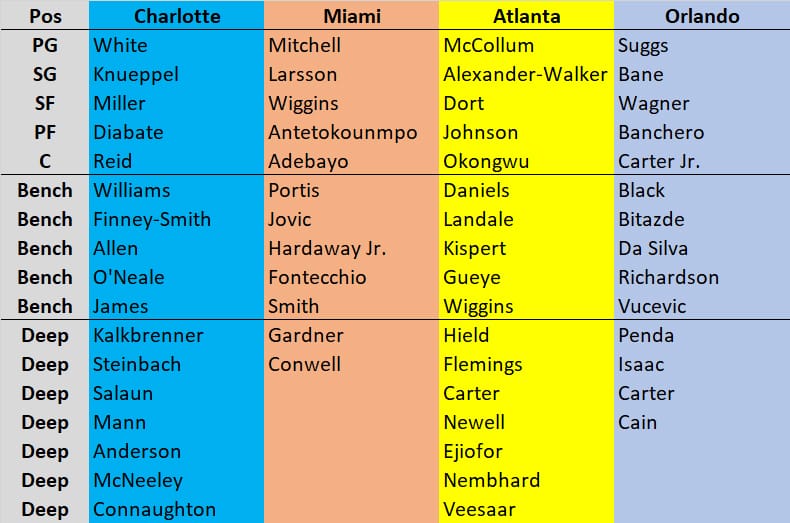
Miami and Orlando don't have enough bodies
No team in the East has fewer players signed to standard contracts than do the Heat. They just have 12, and one of them – Ryan Conwell – was their second-round pick this June. Interestingly, Conwell played for four different schools in four different college seasons. The NIL era!!!
Historically, Miami under Erik Spoelstra has been really good at turning developmental players into guys who can play on standard contracts. Myron Gardner is an example of that on this team. But they already need two more of those guys if they can't convince any more vets to sign for the league minimum, and even with two more guys, they're going to be functionally short, because nearly half of their team are injury risks. Here are five of their players' games played totals for the past two seasons:
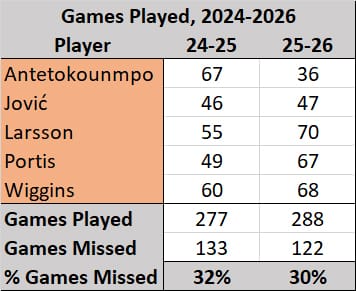
This is three-fifths of what I presume will be their starting lineup, and another player in Bobby Portis who should be an integral part of the lineup when healthy (I have no idea what to make of Nikola Jović at this point). And if they're missing 30% of the games, that is going to put a lot of pressure on the rest of the team.
I think Orlando has the same problem, as two of their high-salary players – Jalen Suggs and Franz Wagner – are tough to trust, health-wise. The consensus seems to be that new coach Sean Sweeney can fix what ails them, and to be sure, I found Jamahl Mosley's coaching to be very strange. Maybe Sweeney will fix them, but his specialty is supposed to be defense, and that wasn't really Orlando's problem. They basically sat out the offseason otherwise, so all improvement will have to be internal. And with the East being deep, I'm just not ready to bet on these players yet.
Atlanta and Charlotte have too many bodies
On the opposite end of the spectrum, Atlanta and Charlotte are very similar in that they have a lot of solid and/or intriguing players surrounded by an almost star (Jalen Johnson in Atlanta and Brandon Miller in Charlotte) and a good running mate (CJ McCollum in Atlanta and Kon Knueppel in Charlotte), but are lacking true top shelf talent. But they're both so deep with players I like or are rookies who could be good that they're really going to be fascinating watches early in the season. Both seem ripe for consolidation trades. I put Atlanta down lower than Charlotte because some of Atlanta's depth is retread/older guys like Corey Kispert and Buddy Hield, and they also have a lot of either/or guys. Kispert and Hield can shoot but don't play D, while Luguentz Dort and Dyson Daniels are just the opposite. So I think that could make it harder for them to find consistent rotations.
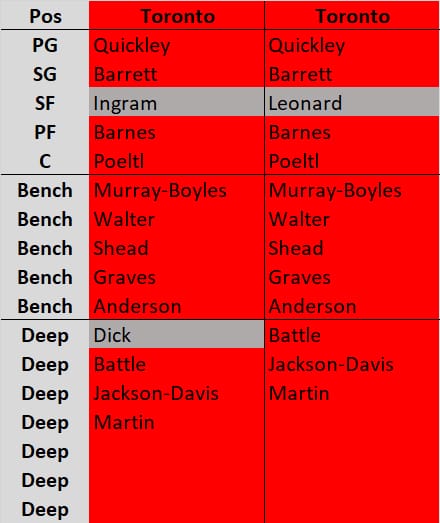
The ceiling of the 2026-2027 Raptors hangs precariously in the balance
It feels impossible to judge the Raptors until there is a resolution to the Aspiration scandal. For Toronto's sake, I hope it is resolved one way or the other before training camp opens, because it is not fair to them, and it is particularly unfair to Brandon Ingram and Gradey Dick. And unfortunately, I think the difference in these two teams could be significant. With Kawhi Leonard, this may be a top-six team; perhaps even the three, four, or five seed if health breaks right for them. With Ingram, I think their ceiling is the play-in, and perhaps a road play-in team. And the longer they have to live in limbo, the harder it will be for them to prepare for the season. Honestly, the whole situation is an abomination, and calls into question whether the league needs a new commissioner.
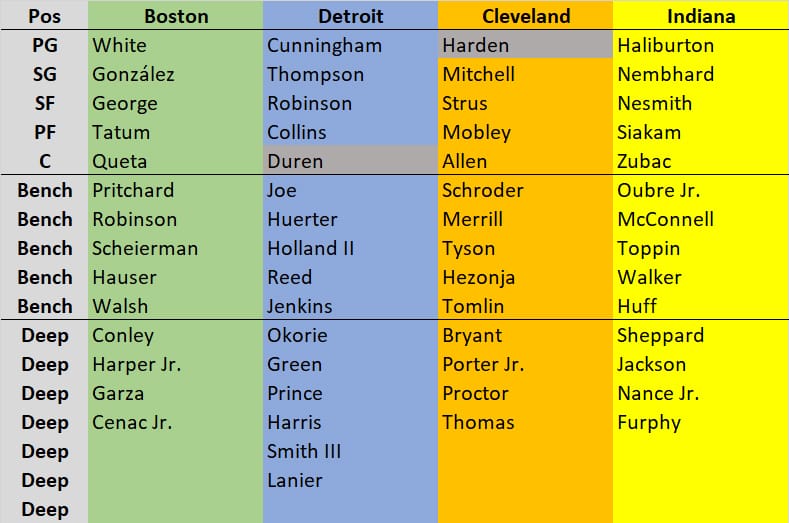
Boston, Cleveland, and Detroit are deep, but their depth doesn't make sense yet
Boston has to figure out several big things:
- Who is starting in the back court alongside Derrick White (my vote remains Hugo González)?
- What is their wing rotation going to be?
- What are the roles going to be for Luka Garza and Mike Conley on this team, if any?
- Is Chris Cenac Jr. going to play, and if so, at which position?
- What will the plan be for the many, many games Paul George doesn't play?
From there, they can move to smaller questions, like who starts at center (I think given Mitchell Robinson's health concerns, Neemias Queta has to start), and how many minutes per game they are targeting for Jayson Tatum. But the lineup combinations for this team are myriad, and while I trust coach Joe Mazzulla to find a great balance, who they are as a team is going to be in question until they do.
Fortunately for the Celtics, the Pistons and Cavaliers have very similar depth/fit questions. What I find interesting about Detroit is that given the composition of their player mix, Jalen Duren may be the most important player on the team, and he may come into camp disgruntled if he doesn't get the contract he wants in restricted free agency. I'm not at all sold on bringing back Kevin Huerter or bringing in Isaiah Joe. And while Daniss Jenkins was a cool story in the regular season, his shot completely vanished in the playoffs (.271 from three). I also think this team is going to miss Tobias Harris.
Cleveland has a mishmash of wings – 6'8" Mario Hezonja, 6'8" Nae'Qwan Tomlin, 6'6" Jaylon Tyson – that ostensibly are backing up Max Strus at the three. But unless this team is planning on giving significant minutes to Thomas Bryant (never anyone's Plan A), these guys are also going to have to get minutes at the four or five when Jarrett Allen and/or Evan Mobley sit/can't play. I don't love that for them. It feels like they need to deal a wing for a big, but I'm not sure any of these guys have enough value to land a big better than Bryant.
Indiana's starting five may be as good as New York and Philadelphia, but they feel short.
Unlike Cleveland's starting five, where Allen and Mobley are still an odd fit, and James Harden and Donovan Mitchell are an even odder fit, Indiana's starting five is both elite and makes sense with Tyrese Haliburton back healthy. I think the only rival to their starting five is in New York and Philly. But like Cleveland, I think Indiana's bench is also a little small.
My big question is – are we really doing the Jay Huff thing again? Jay Huff is like an anti-center. Last season, there were only three players who stood 6'10" or taller who played at least 1,500 minutes and took fewer than 250 two-point shots: Brook Lopez, Noah Clowney, and Huff. Lopez is ancient, and Clowney was completely mismanaged on Brooklyn. And then there's Huff, who's 7'1" and yet averaged only 4.0 rebounds per game. If he's truly going to be Ivica Zubac's backup center, the Pacers are going to have whiplash. Maybe Indiana is going to play small and give center minutes to Jarace Walker and/or Larry Nance Jr., and Huff is just going to be a really tall cheerleader, but if Huff is going to play real minutes, that's going to make the Pacers bench very strange. They're already at a rebounding deficit off the bench thanks to T.J. McConnell. I'm just very surprised the Pacers didn't find another solution at backup center. Until we see how that plays out, and how Haliburton looks, I have to rank them at sixth behind Detroit and Cleveland, even given how killer the starting five could be.
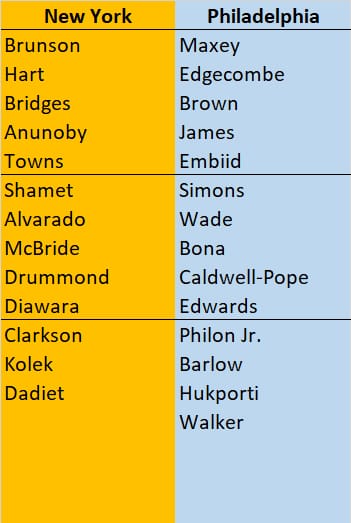
New York and Philly are a cut above
The Knicks' starting five is essentially unimpeachable at this point. The only thing that's going to derail them is health. And I hope it doesn't. I want them at full strength for the playoffs, so they won't have any excuses. They only have 13 guys under contract, but guys 1-12 all played meaningful minutes last season. Andre Drummond should be a hand-in-glove fit in New York as Mitchell Robinson's replacement. Robinson averaged 8.8 rebounds per game last season, good for 13th in the NBA. Drummond averaged 8.4, good for 15th. Drummond isn't the defender Robinson is, but for the financial difference, he's as good as the Knicks could have possibly done. It's really strange living in this reality where the Knicks front office isn't cosmically stupid.
The bench otherwise has a bunch of short guys and 6'9" Mohamed Diawara. I am going to be watching to see if Diawara ends up with a bigger role on this team. I thought he was going to play more in the playoffs last season than he did. With a full season of Alvarado to go with Deuce McBride and the only marginally taller Landry Shamet and Jordan Clarkson, there could be some juicier minutes in store for Diawara. And if so, I think he'll be fine. Even if I have a concern or two deep in the recesses of my brain, the Knicks get the benefit of the doubt that all defending champions get.
In Philly, Adem Bona is going to be a flashpoint, but he had moments in the playoffs. In Game 3 vs. Boston, he posted 10 points, five rebounds and three blocks in 22 minutes as the starting center. Bona, Dominick Barlow, Ariel Hukporti (who had one good stint in the NBA Finals), and Jabari Walker are absolutely good enough to cobble together 15-25 minutes per game when Joel Embiid or LeBron James are not playing center (I expect there will be at least five minutes per game when Philly does this and tries to literally run teams off the floor). The games Embiid doesn't play at all will be different, but when have they not been?
Elsewhere on the bench, prospect analysts seem to think Labaron Philon Jr. can be a player for Philly, and I really like Justin Edwards. I still remember the game last November when Edwards went nuclear in the fourth, hitting three straight threes that turned an eight-point Celtics lead into a one-point Philly lead, which allowed Philly to steal a game it looked like the C's were going to pull out with reasonable comfort. In the 12 games Edwards started last season, he averaged 12.4 points in 26.3 minutes per game on .487/.352/.824 shooting, with a .589 TS%. And this year, he's going to get a lot more wide-open shots. It could be a big season for Edwards, who is eligible for an extension.
And yet, it's not like their bench rides on the performance of Edwards. Anfernee Simons, Dean Wade, and Kentavious Caldwell-Pope are all proven shooters/scorers in this league, and all three are going to provide valuable minutes. Wade in particular will be a boon as the four on the nights when LeBron doesn't want to bang in the paint. As I said a couple of weeks ago, I think reports of the Sixers being thin on the bench are vastly overstated. Philly is going to be really, really good, and at this point of the calendar, is my pick to win the East.