
The Sixth Circle of Hell
A little over a month ago, I was in a celebratory mood, because the Celtics had chosen to not trade Jaylen Brown, and also forced the Miami Heat into giving up so much to acquire Giannis Antetokounmpo that they didn't improve the 2026-2027 version of their team by all that much. I thought that would be the end of it. The Celtics had either come to their senses or never let go of them to begin with, and if mature discussions needed to be had with Jaylen, they would be had, because Brad Stevens is a mature guy who has known Jaylen for a decade, and is up to the task of having them.
Turns out he wasn't!!! And so the Celtics incurred the rare self own. And it was such a disastrous self-own that it looks to me that the Jaylen Brown trade is now on the Mt. Rushmore of the worst Boston sports trades of all time along with the Babe Ruth trade, the Mookie Betts trade, and one of the Jeff Bagwell or Ken Dryden trades (probably Bagwell, since Dryden was just 16 years old at the time and it was essentially a draft-day trade. Dryden would in fact believe for a long time that he had been drafted by the Canadiens).
I have waited to write about the trade, because there still were a lot of moving parts. That functionally comes to an end this weekend, and now we can look back on the six circles of hell that the Celtics fell down in making this trade.
Don't trade Jaylen Brown.
Let's start simple. Don't trade Jaylen Brown! At all! I've been very clear about this – I wanted JB to retire a Celtic. He is no longer a Celtic for two reasons. The first and overwhelmingly most important reason is because Celtics "owner" Bill Chisholm doesn't really have the money or influence he purports to have:
(Shoutout to my old friend and colleague Joon Lee who collaborated on that video.)
As I'm sure you've read by now, JB is soon eligible for an extension that would pay him upwards of $70M per season. The media has spun its intricate webs about how he's just not worth that money, and my retort to that would be that I simply do not care. Jaylen Brown won a championship here, keeping him gave the C's the best chance to get another one, and he did (and still does) an overwhelming amount of good for the city of Boston. I really do not think you should own the Celtics if you're not willing to pay the piper. Quite simply, pay that man his money.
Bill Chisholm and/or the people who pull his strings (unfortunately for Chisholm, he's the public face, so he is going to get all the criticism) didn't want to do that. They are thinking in terms of investment, not brand building or public sentiment, and they deemed him a bad investment. That is a mistake. I was on board with letting go/dealing away Kristaps Porzingis, Jrue Holiday, Al Horford, and Luke Kornet. They were a combination of old, injured, and replaceable. Jaylen Brown is none of the three. What's more, the Celtics had already ducked under the luxury tax, and received no short-term financial windfall from the trade. Trading him was solely about not having to pay him money in the future. And in making that decision, they may have sacrificed the Celtics' window to win another title with Jayson Tatum. And that fucking sucks. Do not pardon my words, because I don't need to be pardoned for them. I'm furious, and always will be. If the C's didn't still have Tatum, I probably wouldn't bother going back to TD Garden. I haven't paid for a ticket to a Red Sox game since the Betts trade, and have absolutely, positively, zero plans to do so in the future.
The other reason JB was traded is because Brad Stevens clearly isn't the mentor to JB, or the great communicator, he professes to be. He wasn't capable of having a tough conversation with JB about not giving him that extension. He wanted to make it someone else's problem, and when he realized the only way to do that was to trade him and trade him now, he panicked and took 10 cents on the dollar. Let's go through this disaster step by step.
This offseason is the wrong time.
If we can accept the incredibly shitty premise that JB would be traded, it didn't make any sense to do it now. Players bring back a lower return in the offseason than they do at the trade deadline, for starters. Players also bring back more when they have one and a half to two and a half years left on their deal. Brown has three, and again, is eligible for an extension. He was always going to bring back less with the extension decision looming, because teams would prefer to know exactly what contract situation they are trading for, and JB's is unresolved.
Add all that up, and now – July 2026 – was just not the time to trade him at all. But even within the month of July, there is a dramatic difference in timing.
The start of free agency is the wrong time within the wrong time.
You are definitively going to get less in trade at the start of free agency, because teams have options. Free agency has just opened! There are dozens of players to sign that there wasn't a week ago! When teams have options, they'll take the less expensive option. Look at the Karl-Anthony Towns trade – that happened in October, when all league business had been transacted. The week free agency opens is basically the absolute worst possible time on the NBA calendar to make a big trade in terms of your return, unless it is a sign-and-trade type of situation that essentially amounts to a free-agent signing.
It's also the worst possible time because it gives the team you trade him to a chance to build around their newly acquired player. We'll come back to that.
You can't trade a superstar for 10 cents on the dollar.
The return is completely secondary when you're talking about a franchise cornerstone player who nobody wanted traded. But if you're going to do it, you can't do it and only get a pittance. But when you do the trade at the absolute worst possible time on the NBA calendar, that's what you're going to get.
Paul George is a lot of things – he's old (for a pro athlete), he's a cheater, and he's a choker:
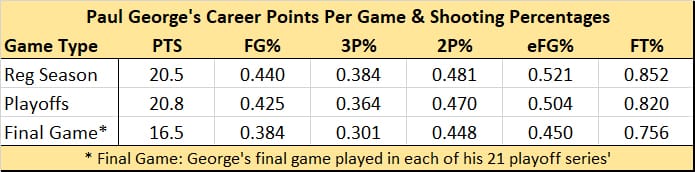
No one wins every playoff series they play in. But there are generally two types of reactions for star players in defeat. One is, "well, it wasn't their fault, they gave their all," and the other is "we might have had them if he had played better." George generally slots into the latter category. We could detail the egg he laid in Game 7 of the 2013 Eastern Conference Finals or Game 6 of the 2018 first round or Game 7 of the 2020 Western Semis. George has never gotten the flack that James Harden has for his playoff failures because George has never been quite good enough for people to care, but those are three pretty flame-y flameouts. They're also all ancient history, because he's old. And in the aggregate, you can see that when a series is decided, George's shooting and production wilts. Not great, Bob!
George is not only way past his prime, rarely healthy for more than a few games at a time (last season, he had only three instances of playing more than three straight games), but his contract is an albatross. In Major League Baseball, where you can have as many big contracts as you want, this wouldn't be an issue. Or at least, not the debilitating issue that is in the NBA's nearly-hard salary apron environment. It limits the Celtics' ability to compete for a championship. If that is in fact still their goal.
Unfortunately, he's the only short-term return, because the rest of it is draft picks. To be fair, the picks may be quite good. Here's the breakdown, from the venerable Brian Robb of MassLive:
- A 2028 first-round pick: The Sixers own two first-round picks (their own and the Clippers’) so Boston will end up with the more preferable of those picks.
- A 2031 first-round pick: This is an unprotected pick from the 76ers.
- A 2028 second-round pick: This would be the most favorable pick among the Warriors, Thunder or Bucks selections.
- A 2030 second-round pick: This would be the most favorable pick among the Blazers, Suns or Wizards picks.
The Clippers are the team to focus on for the 2028 pick. The summer of 2027 is a real hinge moment for the Clippers – it's when Kawhi Leonard's contract expires (if he's not traded), and just about every salary they have is due to expire in that summer. So that may be the moment when the Clippers re-load and build a new nucleus. Or, if the NBA punishes them harshly for the Aspiration scandal, they could still be in purgatory. Either way, at this moment, I think we can say that their outlook is less rosy than Philadelphia's. In contrast, by 2031, Philly may be quite bad, which could make that pick valuable.
Unfortunately, 2031 is a long way off. I don't care about 2031, because in 2031, Jayson Tatum will be entering his age-32 season. He'll still be great, but he may no longer be at the peak of his abilities. He may also not be here anymore, because the C's have now proven they're willing to trade franchise icons even when they're at the peak of their powers. Regardless, the goal should be to win it all in one of the next three seasons to maximize Tatum's prime years (specifically 2027-2028 and 2028-2029), and unless the two 2028 picks are absolute home runs, they will contribute nothing to this goal unless and until they are traded. And George is an extremely suboptimal allocation of resources.
We could go through history and detail why this was a paltry trade return in comparison to other deals, but we don't even have to go through history. The Jazz just got more draft capital in their sign-and-trade for Walker Kessler, and did so without having to take an albatross contract. And Walker Kessler may suck. He just spent nearly all of last season on the shelf.
Don't make it worse by insulting the player on the way out the door.
Jaylen Brown had to listen to a lot of talk about how he didn't want to share the ball with Jayson Tatum, that he wanted "his own team" – two things he never, ever, ever said publicly – and so much more. JB is not shy. From criticizing referees to Joel Embiid to Nike to Grant Hill, etc., if JB is unhappy with you, you're going to hear about it. We get more of JB's opinion than just about every other player in the league, thanks to his forthright interviews with the media and his Twitch streams. So when people make these proclamations about JB without him saying so himself, where is that information coming from? You think maybe it's from the team that's getting raked over the coals for trading him?
The Celtics did a great job of laundering their criticism of JB through the media, sowing the seeds of doubt about his character the same way Boston teams have sewn the seeds of doubt about players they have traded away for time eternal – Nomar Garciaparra, Mookie Betts, Manny Ramirez, Antoine Walker, the list is endless, and the playbook is always the same. The Celtics were clever enough to not commission a Bob Hohler hit piece, but there was little subtlety otherwise. The Boston and national media like nothing more than bagging on a player on his way out the door. Mookie Betts supposedly wasn't going to sign a below-peak contract with the Red Sox before reaching free agency, only to turn around and immediately sign one with the Dodgers. Oops!
The difference is how much more JB is fueled by those slights than other players, which is something you'd think the Celtics would understand. Somehow, they didn't, or decided they didn't care because they were desperate to change the narrative, and kicked him on his way out the door anyway. And then JB went out and did exactly the opposite of the slander that people slathered on him in helping his new team recruit LeBron James. Hard to say he wanted his own team when he's out recruiting other stars!
Don't trade your star player to a team within your division.
All of these bad factors came crashing together in a perfect shit storm for the Celtics specifically because the team they chose to trade him to is their most bitter rival, the Philadelphia 76ers, who just happen to play in their division. The NBA has de-emphasized divisions, but they still exist, and being a division winner is the second-most important playoff tiebreaker after head-to-head record. And in trading Jaylen Brown to the 76ers, and doing so at the start of free agency, and doing so while insulting him on the way out the door, the Celtics created their worst-case scenario (we'll get to this in a later piece, but if the Raptors do end up with Kawhi Leonard, it's conceivable that the C's are now the fourth-best team in their five-team division. Thank goodness for the Nets!).
Make no mistake, the entire reason LeBron James signed with the 76ers is because they got JB. His agent, the all-powerful Rich Paul, said so specifically in the wake of LeBron's "final" decision:
Ultimately, Paul said, the Sixers became much more attractive when Philadelphia acquired Jaylen Brown in a trade with the Boston Celtics on July 1. Adding Brown alongside Tyrese Maxey and Joel Embiid made the Sixers the ultimate choice. James said on X that he made his decision with a shot at a fifth championship in mind.
"Ultimately, Philadelphia makes a move and then boom! Now you got Jaylen Brown," Paul said. "Now hold on, wait a minute now. This looks a lot different."
That sound you heard is me repeatedly vomiting. Thanks, Brad.
It's not just LeBron, as Anfernee Simons and Kentavious Caldwell-Pope also signed up for this rodeo, giving the 76ers valuable depth (again, we'll cover this more soon, but if you hear anyone say the 76ers have no depth, do not listen to those people – they have a very, very good rotation that is 10 deep now, and will only get deeper come buyout season). Last season, LeBron ($52.6M), Simons ($27.7M), and KCP ($21.6M) combined to make ~$102M in salary. Next season, the 76ers will pay them ~$14M. These are three very high-level players, who are incredibly motivated to win a championship. For James, it would be his fifth ring, vaulting him into even more rarified air. For Simons, it will be his first real chance to get a ring, something he specifically cited in talking about why he signed with Philly, and was specifically denied just when he was rounding into form last season before the C's exiled him to Chicago. You think he's going to remember that? I bet you he does! And for KCP, a ring with Philly would make him just the fifth-ever player to win a ring with three different teams (along with LeBron, Danny Green, Robert Horry, and John Salley). None of them would be here without the JB trade, and all of them come to the Sixers at a huge discount specifically because of it.
These are the knock-on effects of adding a superstar in his prime who just finished sixth in the MVP voting, and who has shown through his own direct words and actions and unwavering commitment to his teammates. Other players respond to this. These post-trade unintended/uncontrollable consequences are why you simply can't trade a star player within your division.
...
Maybe the C's could have survived trading Jaylen Brown in a vacuum. Maybe the C's could have survived trading Jaylen Brown at the worst possible time on the calendar in a vacuum. Maybe the C's could have survived trading Jaylen Brown for 10 cents on the dollar in a vacuum. Maybe the C's could have survived trading Jaylen Brown and then motivating him by insulting him on the way out the door in a vacuum. But the C's did all of those things and in doing so sent him to a team in their own division, to the team that is its most bitter rival. That's six levels of hell they circled down in the process (pun intended) of making this trade.
The C's stand very little chance of surviving all of that. Worse, the only strategy for doing so appears to be Brad Stevens cosplaying as Princess Leia: "Save us Jayson Tatum, you're our only hope." I'm going to root like hell for that, because Jayson Tatum is my favorite player, and I'm now terrified that the C's will trade him if he does anything less than deliver the team back to the Conference Finals. Because if you're willing to trade Jaylen Brown after the season he just had, then you're willing to trade anyone, and therefore, we can no longer give this ownership group the benefit of the doubt.
In the Inferno of Dante's The Divine Comedy, the sixth circle of hell is reserved for heretics, those who have denied the prophecy. The prophecy that Danny Ainge gave Boston was that Jayson Tatum and Jaylen Brown would lead the Celtics and the city of Boston to greatness. In short circuiting their dynasty by trading JB when it wasn't necessary, Bill Chisholm, Brad Stevens and Co. have proven themselves heretics, and dropped us all down to the sixth circle of hell, which is far too close to the three lowest, most foul circles of hell. And in doing so, they helped turn the hated 76ers – a team that as little as a month ago had two albatross contracts and absolutely no path back to the NBA Finals – into a juggernaut.
Sigh. At least we had a lot of good times.