
The NBA Got Halfway There

The NBA tweaked the All-Star format again. I'll admit, I'm morbidly curious to watch. Perhaps you are too. After all, I'm a person writing a basketball newsletter, and you're a person reading one. We're not necessarily the target demographic for all of this, as we're likely to watch no matter what. The NBA isn't trying to capture our attention, because they believe they already have it. They're trying to capture the attention of the casual viewer, and are trying to do so by tricking the participants into trying. And they got close this year, I believe. Perhaps by accident. But they didn't get all the way there.
One thing we know for sure is that the All-Star participants can't be tricked into caring via money. The money the league offers up in reward for winning this game is a paltry sum to the stars, and thus anyone for who it might be more meaningful is going to play it cool and pretend it isn't. And the league correctly doesn't want to go to making the stakes of the All-Star Game have anything to do with the real games of the regular season. Major League Baseball tried that and it was lunacy. So, what's left? Pride.
I wrote last year that to me the best idea was to put the most tenured All-Stars on a team and give them a bye, and that they should get to play the winner of the first mini All-Star Game. I still feel that way, but now I have it fleshed out a little more, and want to make it completely about generations. You have the young bucks, and you have the prime players, and the old heads. You would separate them out by number of All-Star selections, and use age as a tiebreaker.
This is how the rosters actually shook out in real life:
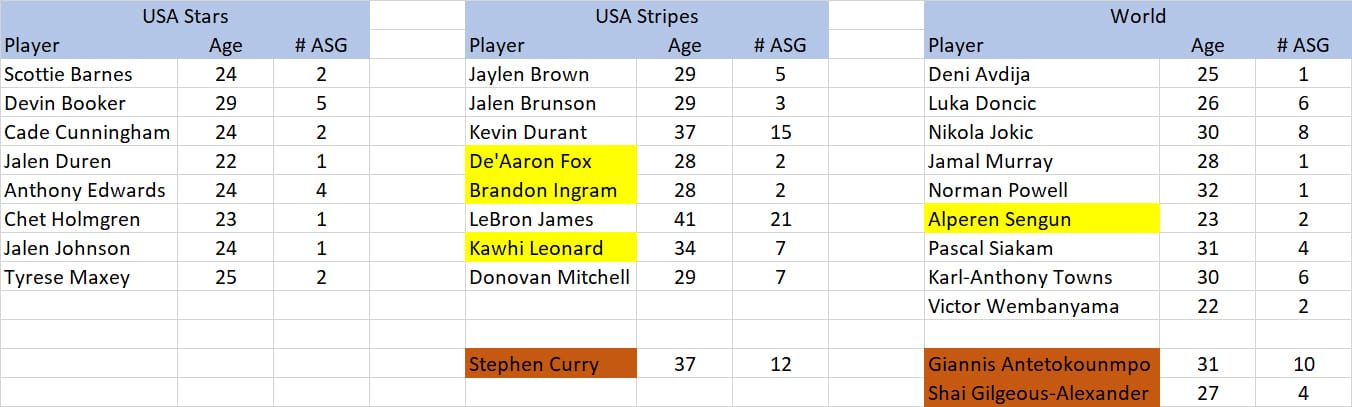
You can see one problem right off the jump. We ended up with 25 All-Stars. Oops! Kawhi Leonard was named an All-Star because of a lack of USA players, and then there was some jockeying around when guys got hurt, and we ended up with 25 All-Stars instead of 24. The lie was also put to the concept of USA vs. World right away, when Norman Powell and Karl-Anthony Towns were eligible to play for both USA and World. Kind of defeats the purpose if it's not definitive. Either way, this is a massive problem. If you care about the history, then it's just going to look weird that this season there are 25 All-Stars.
Here's how it would look if we did it my way:
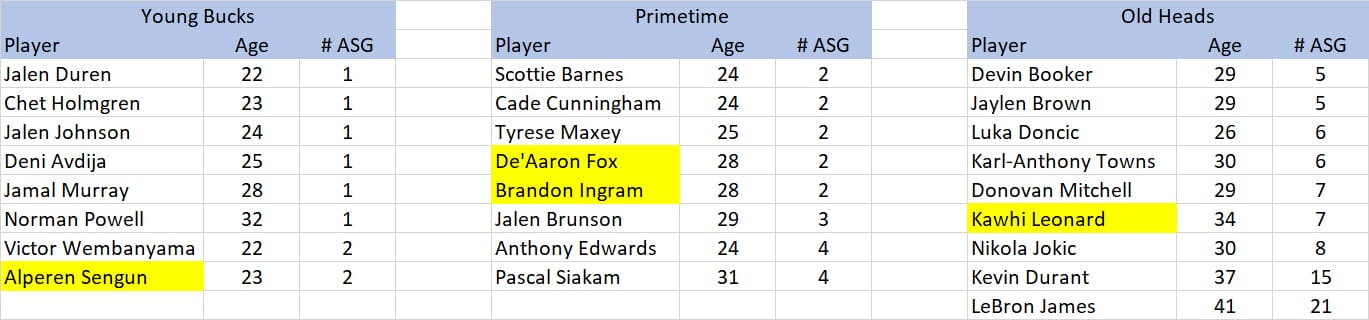
A couple of things. One, I gave the extra player to the old heads, because that seemed fair. If LeBron James doesn't want to play, now he doesn't have to. Also, it just kind of broke that way with two five-time All-Stars on the cutoff line. You can see also that there are several two-time All-Stars on each of the Young Bucks and Primetime teams. I used age as the tiebreaker.
For starters, this set up is cleaner to understand for fans. You know exactly where players will fit in if there are injury replacements, because it's based on objective facts that you can't switch. No switching nationalities to balance the rosters. Save that madness for the Olympics and World Cup. And you don't have to make jokes about the imaginary legacy of "Team USA Stripes" because now you've removed that arbitrary construct from the proceedings. You can actually build an identity around each of these teams I've created, and have these two games to see who the league truly belongs to.
Young Bucks would play Primetime for one half of basketball – 24 minutes – for the right to play Old Heads (you can also go with Legends, or Veterans, or whatever) to crown a champion. This is the way life works. You come up, and to become the king, you gotta dethrone the king! This would be compelling basketball. Instead, the NBA is going to try to force jingoism into the game, at a time when that nationalistic pride is incredibly complicated and layered. There just couldn't be a worse time for this.
The main benefit of my system is you can do away with the round robin tourney the league is going to do tomorrow. They have to do the round robin tomorrow because it's not clear which of the three teams the league has built could possibly deserve to have a bye, but doing it my way makes it very clear. "Deference to your elders" is something everyone will implicitly understand, and no one would argue that. The whole reason LeBron didn't play last year and Stephen Curry isn't playing this year is because they're old and they want to save their bodies, which everyone gets. Doing it my way, they only have to play one half of basketball, and that would hopefully make them less likely to bow out and fake an injury.
Moreover, the league kind of already agrees with me. The way the USA rosters were constructed for tomorrow, you can see the bones of my version already in place. The players on Team USA Stripes combine for 62 All-Star appearances, whereas those on Team USA Stars combine for 18 total All-Star appearances (or three fewer than LeBron all by himself). Only Devin Booker got shafted on to the younger ream (they should really switch one of De'Aaron Fox or Brandon Ingram into Booker's spot and get Booker on the team with the older players, but I digress). Let's just do that for all three teams!!! It'll be easier to understand, and it might just be more competitive. The main reasons these games are never taken seriously is because certain players don't try hard, and the best way to get guys to try hard is to put them with their true peers and put their pride on the line.
The NBA nearly got all the way there this year. Let's remove the USA vs. World construct and get all the way there next year.