
Nothing and Everything Is Different
It's easy to not ask the obvious question. In a macro sense, the country spent the last decade asking the obvious question of whether we are better off than before, until things finally got so bad this past year that the question could no longer be ignored, and the blue tsunami was the (hopefully just first) result. But in looking at something far less important like a basketball season, it's very easy to not ask obvious questions. Each game brings different challenges, storylines, and most importantly, new information. In addition, in the first few games of a season, you don't want to overreact to that new information, which also pushes you to not ask the most obvious question. And this season, the most obvious question is – what's different without Jaylen Brown? The answer, I think, is that nothing and everything has changed, and I think you can see the differences when contrasting the 12th games of last season and this season.
Last season's 12th game was in Philly. This was the "Jordan Walsh guards Tyrese Maxey!" game. The C's had a decent lead in the fourth until Justin Edwards went nuclear from three. Jaylen Brown had a chance to give the C's the lead with 33 seconds left but only hit one of two free throws, leaving the game tied. He then got himself and the defense as a whole out of position needlessly chasing Tyrese Maxey on a double team – Jordan Walsh had him the whole way. But when JB chased, it left Justin Edwards – the guy who had 13 points in the quarter, and who had hit his last three three pointers – with a wide-open three. Maxey kicked it to him, and while Edwards mercifully missed, Payton Pritchard, who had been guarding Kelly Oubre Jr., had to jump out and challenge Edwards. JB never returned the favor and picked up Oubre, who got a free put-back lay-up to give Philly the lead back. On the ensuing final play with 8.7 seconds, JB panicked and threw a bad pass to Derrick White, who had the ball bounce off his leg out toward half court. D White had to heave it from there, and the shot never had a chance.
It was a pretty disastrous final 33 seconds. It's the kind of thing I immediately forgave JB for in the moment, because the C's were shorthanded without Tatum, and at that point – 5-6 and in a dog fight on the road against a Philly team missing both Joel Embiid and Paul George – no one foresaw a 50-win team. But it was also clearly a game the C's should have won, and JB's play in crunch time left a lot to be desired. He was too sped up and didn't have a real plan at any point. The loss dropped the C's to 5-7, and down to 11th place in the East.
Contrast that with what happened in the 12th game of the 2026-2027 season on Wednesday. The C's were on the second leg of a road-road back-to-back after an emotional game, and were playing without one of their two best players (I'm ready to admit that now) when Paul George sat. Mitchell Robinson might as well have sat as well (it's nice that Mitch is trying to play back-to-backs, but so far it's been counterproductive), as he was ineffective and only played two minutes in the second half (and none in the fourth quarter). Toronto took the lead halfway through the first quarter, and held it for two quarters straight, and into the fourth quarter after Boston briefly reclaimed it for a hot second halfway through the third.
Jayson Tatum, the team's unquestioned best player now, couldn't hit the broad side of a barn in this one, particularly in the second half, when he went 1-for-8. With the Raptors relentlessly double teaming and aggressively trapping him out by half court, he had no flow, no rhythm. Yet rather than trying to force his way through those double teams and being loose with the ball, he just kept making the right decision, even though in most of those cases he wouldn't get credit for assists, because nearly every open shooter was two passes away.
He also sensed the moment. His one made bucket of the second half came with two minutes left, and it gave the team the lead. He caught an inbounds pass from D White, and put up a quick fadeaway jumper over RJ Barrett without dribbling, denying Toronto the opportunity to send help. It swished through, and gave Boston their first lead of the fourth quarter. A minute later, he stayed patient, and used Sam Hauser as a screener instead of Neemias Queta in order to ward off double teams (you can't just leave Hauser open), and patiently worked the ball down into the paint, where he was able to get Queta an easy dunk. Then he struck fast. With three Raptors, including center Jakob Poeltl, up top, there was no one under the rim:
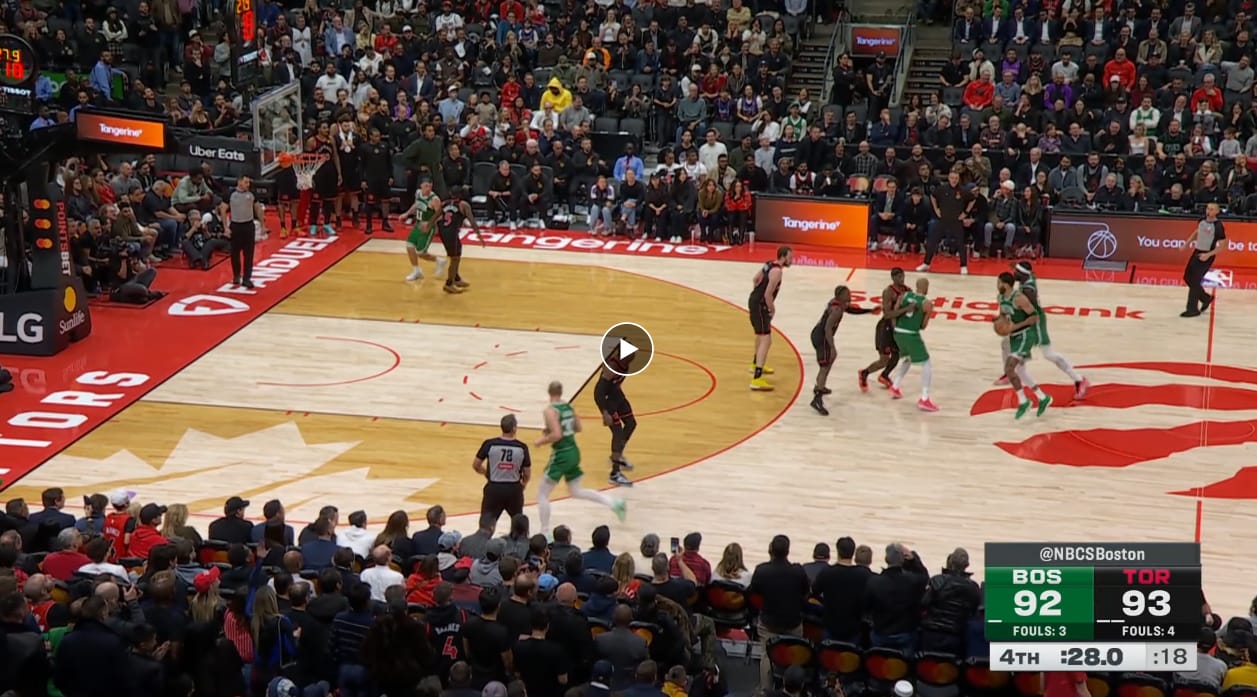
Tatum had been methodical and pulled it out on the prior two possessions, so perhaps Toronto wasn't expecting it. Especially because he could walked the clock down to ~10 seconds. But as you can see, there was no one at the rim. So Tatum appropriately drove hard, got fouled, and hit both of his free throws to give his team the lead back. He then, very similarly to JB in Philly the year before, was matched up on Toronto's unheralded sharpshooter, Ja'Kobe Walter. But rather than leave him wide open and put his defense in rotation by doubling, Tatum trusted his teammates, and D White and Neemy were more than up to the task – White funneled RJ Barrett right to Queta, and Queta blocked his shot and iced his two free throws. Toronto would inbound the ball right to Sam Hauser on their final possession, and Boston walked away with the win.
The C's enter tonight's game at 10-2, best record in the East, and behind only the 11-2 Lakers and Spurs out West for best in the NBA. The only thing holding this team back from another 60-win season is health. Last season's 56 wins were tremendous, but in looking at how Boston's stars handled the end of each of these games, it crystallizes things. There are small differences that add up over the course of a season, but those small differences can mean the difference between a 56-win two-seed and a 60-win one seed, which in turn can mean the difference between making another NBA Finals run and exiting in the first round because you drew a more difficult round one opponent than you deserved.
With twelve games, or 14% of the season, in the books, some other things have crystallized. Let's dig a little deeper for a few minutes.
Roles and Minutes
Everyone's roles fit better. Despite a few double big iterations that Joe Mazzulla just can't seem to help himself from, the team is essentially playing one big, one point guard, and three wings at all times, and it's tough as hell. The only really rough stretches have been the start of the second and fourth quarters with Jayson Tatum on the bench in the games Paul George has sat out. Offense was a little hard to find in those situations, but it was four ~six-minute stretches against two very good defenses in Houston and Toronto. Let's not overreact.
The rotation has solidified, particularly at center. Neemias Queta is now the unquestioned starter. When all three bigs are available, Queta plays roughly the first six minutes and final six minutes of each half. Mitchell Robinson is first off the bench, and his minutes form a Luka Garza sandwich of sorts. That leaves each half looking something like this: Queta (six minutes), Robinson (four), Garza (four), Robinson (four), Queta (six). It nets out to Queta at ~24 minutes, Robinson at ~16, and Garza at ~eight. That's exactly how it should be. The actual totals will fluctuate based on foul trouble and when the whistles actually blow (you can't force the refs to blow the whistles at precisely six minutes left in a quarter). But this rotation they've settled on is, in my opinion, perfect. If Robinson better learns the defensive rotations and how the C's do things, perhaps he can be trusted in crunch time as the season progresses, but the bet here is that he won't know it as well as Queta will. Not this season, at least. And honestly, Queta is just better.
Outside of center, Tatum is back to his play the whole first and third quarter, and the final half of the second and fourth quarters routine. The team usually loads up with either two or three of the other starters plus Pritchard in the non-Tatum minutes to make sure there isn't a huge dip with him off the court. One of the wings – usually Baylor Scheierman or Hugo González – usually doesn't enter the game at all in the first quarter, but will start the second quarter to give the team fresh legs at that juncture. And the fifth starter – usually Jordan Walsh – may sit for a full quarter after his stint as a starter to open the game. He may also sit in favor of Sam Hauser at the beginning of the second half.
Zooming out, one big thing through the first 12 games is that no one has an extraordinary minutes load:
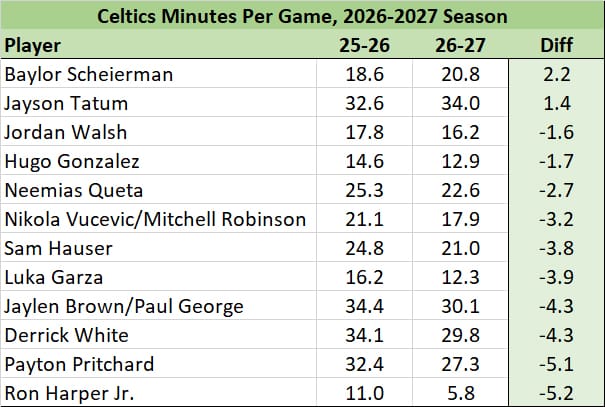
As you can see, just about everyone's minutes are down compared to last year. Rather than compare George and Robinson to their actual minutes per game last season, I compared them to the players they essentially replaced in Jaylen Brown and Nikola Vučević, as I feel that is the better comparison for how everything fits together for the team.
Scheierman's minutes are up, as they should be, because he's earned that. Tatum's minutes are up, as they should be, because he was playing a slightly reduced load when he returned from his Achilles injury. But Tatum's minutes are still below his career average (34.4 minutes per game), his 2024-2025 average (36.4), and his average across his three prior healthy seasons of 2022-2023 through 2024-2025 (also 36.4). So he's down in that sense, which is tremendous. As is the rest of the team. Most notably, White and Pritchard are way down. I've talked about how both were worn out by the time the playoffs started last season, so this is an encouraging sign, especially considering they're the only two steady point guards. Joe Mazzulla has done a masterful job of balancing the minutes thus far.
Offense
There's three big differences here. One big, big difference Paul George is a much better three-point shooter than JB. That doesn't require a lot of analysis. He's just better, and you can feel it most in the bail-out possessions where nothing is happening, and someone needs to take a shot.
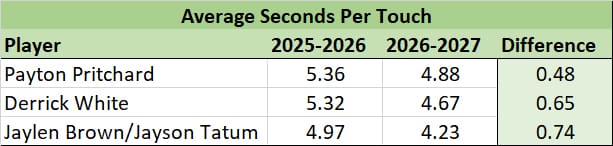
Another gigantic difference is the fact that the team as a whole is just getting off the ball much quicker, and that effort is being led by Jayson Tatum. Tatum's time of possession per game ranks 36th in the NBA, tied essentially with Ja Morant, Jamal Shead, and Mikel Brown Jr. In terms of average seconds per touch, he ranks 85th out of the 220 players who average 20+ minutes per game, and just third on the Celtics behind Payton Pritchard (53rd) and Derrick White (61st). And it's remarkably less than in 2024-2025. That season, Tatum's average seconds per touch was 6.76. This season, he's at 4.23. And let me tell you, you can feel those two and a half seconds, and it is reverberating across the team.
It's a stark contrast to last season, when Payton Pritchard (24th), Derrick White (25th), and Jaylen Brown (31st), all ranked in the top 31 in terms of time of possession, and all three were holding the ball longer:
Along with getting off the ball quicker, JT is also getting into the paint more than ever. His free throws attempts per game are a clear indicator, and his 8.9 free throw attempts per game are a career high. But his percentage of shots taken from zero to three feet is also way up. He's taking 23.9% of his shots in that range, which is the fourth-highest mark of his career and his highest since 2019-2020. Across 2022-2023 through 2024-2025 (his last three full healthy seasons) he was at 21.3%. In general, he's just taking more two's than three's. His percentage of his two's in his past two seasons was 50.3% and 50.2%. This season, he's taking 60.1% of his shots from two-point land. This is again his highest percentage since early in his career (2020-2021).
The effect is he's not only improving things for himself but others as well. According to Databallr, his Rim Assists per 100 possessions – by their definition, "assists that lead to made baskets at the rim (within close range of the basket)" – Tatum is in the 94th percentile of the NBA at 3.4. While his RimAst have steadily gone up throughout his career, this is a big jump, as last season's 1.9 mark (90th percentile) was his career high. That jump from 90th percentile to 94th is a dramatic jump, and shows how Tatum is changing the offense dramatically with just a few tweaks to his game. It's almost like watching nearly a whole season from the bench helped him learn some things!
The final difference is that George's style allows for a more varied offensive attack than did Brown's. He is just more fluid with the ball. A lot of JB's actions were dependent on him doing a lot of dribbling, because JB needed more time to read what was happening on the floor. He was an expert at doing so if he had that little extra time. But George doesn't need the extra time – his average seconds per touch is just 3.31, which is even lower than Neemias Queta at 3.35. George also isn't anywhere near as athletic at this stage of his career, so that's the tradeoff, but the added variety on offense is improving things for everyone, whereas JB's attacks primarily only improved things for JB. It makes the team much more dangerous, and you could see it in the Philly game.
Three Party
The game against Philly was a testament to the seemingly very different ways the Celtics are attacking on the offensive end this season. In the game, they launched a season-high 49 threes. Forty-two of them came before the game effectively ended at the 5:35 mark, which is when Philly called a time out and pulled their starters. I'd say it's when they raised the white flag, but in re-watching the game yesterday, LeBron James had essentially waived the white flag a couple of minutes prior.
As I re-watched the game, I chronicled all 49 threes taken in the game, as a way of trying to establish how the team was running offense. I'm not going to break it all out for you, because honestly it's too much information to be useful, but I did notice several clear trends. The biggest to me is that the team now attacks in several different ways. In the past, it was mostly drive-and-kick and isolation shooting off the dribble. But now that everyone on the team has a solid handle (outside of maybe Jordan Walsh), the team is now mixing in a lot of threes where players curl around screens, dribbling behind screens in open space (that's definitely new), and they are breaking out the double screens to get wide-open shots at will.
The double screen action was noticeable in the third quarter. Payton Pritchard had the ball up top. Jayson Tatum screened VJ Edgecombe, who was guarding Pritchard. Then Mitchell Robinson screened Dean Wade, who had been covering Tatum. When Robinson does this, Joel Embiid drops behind Robinson, and poof – there is no one to guard Pritchard, who drilled his wide-open shot. They would do nearly the exact same thing the next time down the court, and it's clear that it's a fluid play they have practiced a bunch.
...
Zooming out, not a lot really has changed in the macro sense. Like last season, the team is led by a single star, with great depth and complementary pieces around him, and there may be an argument to be had that the team deserves a second All-Star, just like last season. The team is playing smart and sophisticated basketball. They shoot a lot of three's, they play hard without fouling, etc. They are relentless and almost never concede a game or even a possession. They leave everything on the floor, and are both extremely enjoyable to watch and incredibly easy to root for. Their head coach and coaching staff are smarter than just about everyone else's and it creates a competitive advantage for the team, as does the front office. You can't say enough about players the team found for free like Neemias Queta and Ron Harper Jr., and how they've developed the players they find deep in the NBA Draft. If Chris Cenac Jr. ever gets a chance to play, I am confident he'll be the next success story.
But there are differences between this season and last season. The offense isn't necessarily better now. According to Databallr, the offense ranks sixth-best in the NBA this season as compared to second-best last season. But the offense succeeded in only one fashion last season – be careful with the ball, don't turn it over, and crash the glass. This season, the team is succeeding because they're shooting better. And they're shooting better because they're varying the attack more, and moving quicker. And that's where you'd rather be. The Celtics offense was too easy to figure out once the playoffs started last spring. It looks like it'll be a lot more dynamic this season. And when Mitchell Robinson learns the offense better and rounds into better shape, he should be able to crash the glass better, and then it'll all be working.
The defense has of course been a factor as well, but this post is long enough as is, and I think we need more time to see if the early-season efforts to get into the passing lanes more holds up as we get deeper into the season. So we'll leave that for another time.